A robot paper whose real subject is honesty
Robotics is in the middle of a “foundation model” rush. The idea, borrowed from language and image AI, is seductive: instead of training a robot for one task at a time, train one big “large behavior model” (LBM) on a huge, diverse pile of demonstrations, and get a system that is broadly capable and quick to adapt. The enthusiasm — and the investment — is enormous. The headline writes itself: general-purpose robot brains are here.
This paper, from Toyota Research Institute, is interesting precisely because it refuses to write that headline. Its real contribution is not a flashier robot. It is a hard look at a deceptively simple question — does the big-model approach actually work better, and how would we even know? — answered with a level of statistical care that is, by the authors’ own account, unusual for the field. The result is a genuinely useful “yes, but,” and a warning that much of robotics may be measuring noise.
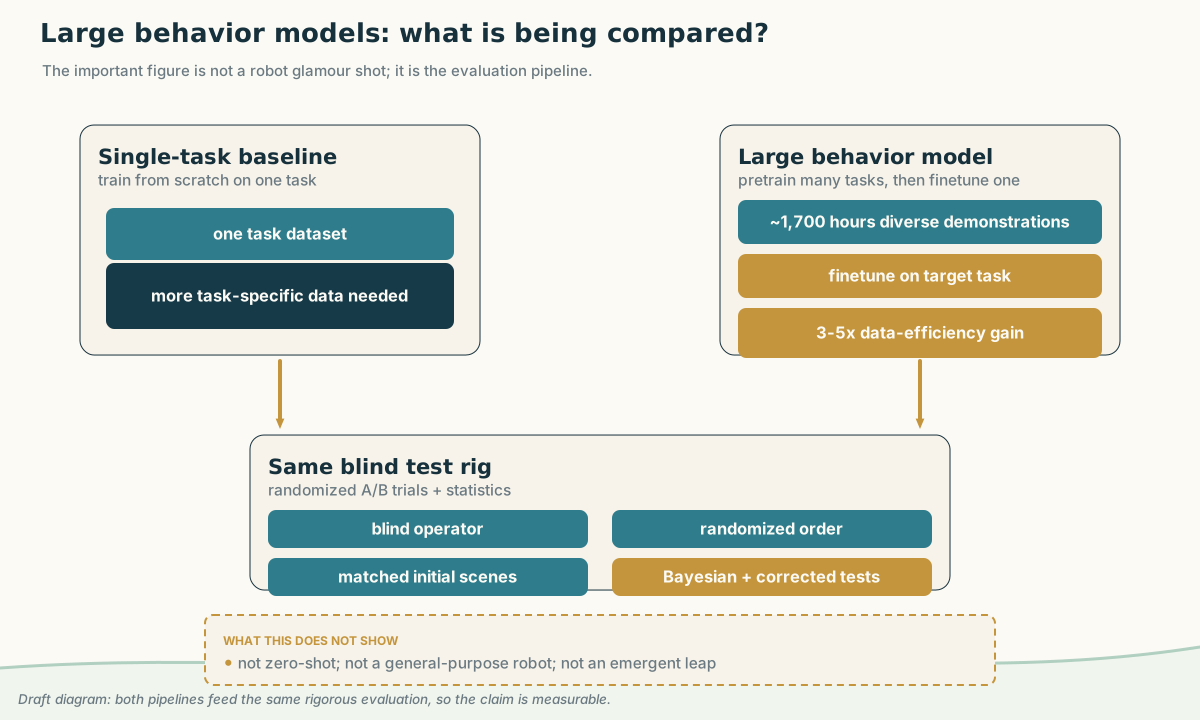
What they found
Finetuned big models beat from-scratch single-task models — on average. Aggregated across tasks, an LBM that was pretrained and then finetuned on a task reliably outperformed a policy trained from scratch on that same task, in both simulation and the real world, and the separation was statistically significant. On individual tasks the finetuned LBM was statistically as-good-or-better than from-scratch in nearly every case (3/3 real-world tasks, 15/16 simulation tasks).
The biggest, clearest win is data efficiency. A finetuned LBM reached from-scratch-equivalent performance using roughly 3–5× less task-specific data. In one real-world task (setting a breakfast table), an LBM finetuned on just 15% of the demonstrations beat a from-scratch policy trained on 100% of them.
Pretraining helps most when conditions shift. When the test environment was deliberately perturbed away from training conditions (“distribution shift”), the finetuned LBM’s advantage grew. In one simulation set, it statistically beat from-scratch on 3 of 16 tasks under normal conditions but 10 of 16 under distribution shift. Since real deployments always drift from training conditions, this robustness is arguably the most practically important finding.
More pretraining data helped, smoothly. Performance rose steadily as they added pretraining data — with no sudden jump or “emergent” leap at the scales tested. Useful, predictable, undramatic.
But the generalist-without-finetuning story did not hold. A pretrained LBM used zero-shot — no task-specific finetuning — did not consistently beat single-task policies. A single network could do many tasks at once, but the “just prompt it” dream was not borne out here; the authors attribute part of this to the brittleness of their small language encoder.
And the gains were small enough to be easy to miss — or to fake. Many of the effects only became visible with the larger-than-usual sample sizes and careful tests. The authors state plainly that, given the size of the effects and the noise, there is significant risk that many robotics papers are measuring statistical noise. They also found that a mundane choice — how the data is normalised — affected results more than architectural changes, and that a normalisation bug in pretraining surfaced only after evaluations were finished.
What this probably means
The defensible reading: large-scale pretraining on diverse robot data is a real, worthwhile ingredient — it makes you need less data per new task and makes policies sturdier when the world doesn’t match training. That genuinely supports the direction the field is betting on. But the gains are modest and conditional (they mostly show up after finetuning, and are clearest in aggregate and under stress), not the arrival of a drop-in general robot.
The quieter, more important meaning is methodological. The paper is, in effect, a measuring-stick: it shows how much evidence it actually takes to make a trustworthy claim about a robot policy, and implies that a lot of published excitement rests on too little. That is a corrective the field needs more than another model.
What this does not prove
- It is not a general-purpose robot. The wins are demonstrated for a specific architecture (diffusion policies) finetuned per task, in controlled settings, from teleoperated demonstrations — not an autonomous robot that does arbitrary new jobs on command.
- It does not validate zero-shot use. Without finetuning, the big model did not consistently beat single-task baselines.
- It is not evidence of an “emergent leap.” Scaling improved things smoothly; there is no discontinuity here to support “and then it suddenly became capable” narratives.
- The numbers are relative and lab-bound. Absolute success rates were deliberately tuned toward ~50% to make comparisons sensitive; they are not a measure of real-world reliability, and the work is one architecture from one lab.
- It does not settle why any policy succeeds or fails, and several specific tasks where the big model did worse are reported but not explained.
- It says nothing about safety, autonomy, or deployment outside the evaluation rig.
How strong is the evidence?
For its central comparative claims — finetuned LBMs beat from-scratch baselines in aggregate, need several times less data, and are more robust under distribution shift — the evidence is strong and unusually well-controlled: blind, randomised, large-sample, statistically tested, with a QA pass on scoring. This is the rare case where the methodology is sound enough to take the headline conclusions at close to face value.
The honest caveats are ones the authors raise themselves. Their error bars capture the randomness of evaluation but not the randomness of training — train the same model twice and you might get a meaningfully different policy, and that variation is not in the statistics. Real-world tasks had 50 trials each, enough to catch medium effects but liable to miss small ones. The language-conditioning used a modest encoder, so claims about “just tell the robot what to do” may differ for larger systems. And there is the candid disclosure of a post-hoc normalisation bug. None of these sink the main findings, but they are exactly the kind of thing the paper argues the field usually sweeps aside.
One sourcing note, in the same spirit: this explainer is based on the authors’ preprint. We were not able to retrieve the journal-published version, so we have not checked for any changes between preprint and published text.
Why it matters
“Robot foundation models” is a phrase built for overclaiming, and a study like this is easy to misread in either direction — as a triumphant “it works!” or a dismissive “it’s overhyped.” The accurate take is more useful than both: pretraining on diverse data delivers real, measurable, but moderate benefits — chiefly less data per task and more robustness — and the path improves predictably with scale.
The deeper reason it matters is that the paper turns its rigor on its own field. By showing that the genuine effects are small enough to vanish under sloppy evaluation, and that a boring choice like data normalisation can outweigh a clever new architecture, it makes a case that much of robot-learning progress needs sturdier measurement before it can be believed. A paper that spends its credibility policing the difference between a result and a wish is doing something rarer, and more valuable, than topping a leaderboard.
Clean summary
Researchers at Toyota Research Institute trained “large behavior models” — diffusion-based robot policies pretrained on ~1,700 hours of diverse manipulation data — and tested them against from-scratch single-task policies using an unusually rigorous protocol: blind, randomised, large-sample (≈1,800 real-world and 47,000+ simulation trials), with real statistics. After per-task finetuning, the big models reliably did better in aggregate, needed roughly 3–5× less task-specific data, and were more robust when conditions shifted, with performance improving smoothly as pretraining data grew. But used without finetuning they did not consistently beat single-task models, several effects were small enough that only the large sample sizes revealed them, and a mundane data-normalisation choice mattered more than architecture. It is solid, measured support for the robot-foundation-model direction — not a general-purpose robot, not a zero-shot generalist, and not an “emergent leap” — plus a pointed warning that much of robotics may be measuring noise.
No-BS check
What the paper shows: With a rigorous, blind, statistically-powered evaluation (≈1,800 real-world + 47,000+ simulation rollouts), multitask-pretrained-then-finetuned diffusion policies (LBMs) outperform from-scratch single-task policies in aggregate, reach equivalent performance with ~3–5× less task-specific data, and are more robust under distribution shift; performance scales smoothly with pretraining data.
What is plausible but not proven: That these benefits transfer to much larger vision-language-action models (their language encoder was small); that the smooth scaling continues beyond the data range tested.
What it does not show: A general-purpose or zero-shot robot (no finetuning → no consistent advantage); any “emergent” capability jump; explanations for specific task-level failures; real-world reliability in absolute terms (success rates were tuned near 50% for sensitivity); anything about safety or autonomous deployment.
Main limitations: Statistics capture evaluation randomness but not training-run randomness; 50 real-world trials per task may miss small effects; one architecture and one lab; modest language encoder; a data-normalisation bug was found after evaluations; analysis based on the preprint (published version not checked).
How much confidence should a general reader have? High that multitask pretraining plus finetuning gives real, moderate benefits — especially data efficiency and robustness — and that these were measured unusually carefully. High that this is not a general-purpose or zero-shot robot and not an emergent leap. Medium on how far the gains scale to bigger models. And worth taking seriously: the authors’ own warning that the field’s effects are small enough that under-powered studies may be reporting noise. Appropriate stance: measured optimism about the approach, and healthy skepticism toward robot-AI results that lack this kind of statistical backing.
Source
Based on: A Careful Examination of Large Behavior Models for Multitask Dexterous Manipulation — Toyota Research Institute Large Behavior Model Team — J. Barreiros, A. Beaulieu, et al.; senior authors incl. R. Ambrus, B. Burchfiel, S. Feng, H. Kress-Gazit (Cornell), R. Tedrake, Science Robotics (2026); preprint arXiv:2507.05331.
Written by
Lucio Vaglio · figures and links by
Laura Nesso · edited by
Michele Renda
· figures and links by
Laura Nesso · edited by
Michele Renda
Editorial note
This article was prepared with AI assistance and human editorial review. It is a clear, conservative explanation of the linked work, not a substitute for reading it. Responsibility for selection, interpretation, and final wording rests with the editor.