A comet from another star, and the fingerprint in its water
Every so often something falls through the Solar System that was never ours. Not a stray rock from the asteroid belt, not a comet swinging back from the Oort cloud on its long leash, but an object on an open, hyperbolic path — one that came in from interstellar space, will loop once around the Sun, and leave forever. We have now seen three. The first, ʻOumuamua in 2017, was gone almost before anyone agreed on what it had been. The second, 2I/Borisov in 2019, was unmistakably a comet. The third, discovered in July 2025, is 3I/ATLAS — and it arrived wrapped in a coma active enough to do real chemistry on.
Here is the part worth holding onto before the noise sets in. An interstellar comet is, quite literally, a chip of another planetary system: ice and dust that condensed around some other star, was most likely flung out by a gravitational kick long ago, drifted across the Galaxy, and happened to pass close enough to our Sun for its ices to start boiling off exactly where our telescopes could watch. That is the genuinely remarkable fact, and it is astonishing enough that it does not need help.
It tends to get help anyway. Interstellar objects attract a particular kind of breathless coverage — the dimmed lights, the but what if someone built it — and 3I/ATLAS got its share. The honest answer to that question is the boring one, and the boring one is more interesting: it is a comet. The real question was never whether somebody made it. It was the quieter one — if you could read the chemistry of something assembled around another star, what would it tell you about that star’s family? And how would you even read it?
The reading instrument, this time, is water. Water is two hydrogens and an oxygen, but a small fraction of its hydrogen is deuterium — a heavier twin, an ordinary hydrogen atom carrying one extra neutron. The ratio of heavy hydrogen to ordinary hydrogen in water, written D/H, is not random. It is set, by chemistry, largely by how cold it was where the water first formed: the colder and quieter the cradle, the more deuterium gets locked in. And because a comet is essentially a deep-freezer — one that can hold its ices in cold storage for billions of years — the D/H ratio of its water can preserve a fingerprint of the conditions under which that water formed.
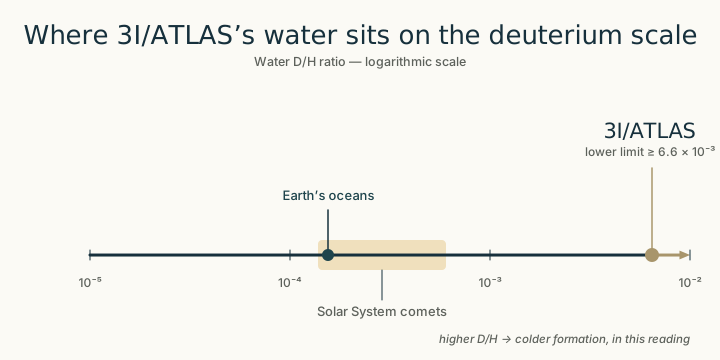
We know our own system’s fingerprints reasonably well: Earth’s oceans and the various families of Solar System comets cluster in a fairly narrow band. What nobody had ever pinned down was that same fingerprint for water that formed around another star. That is what this paper set out to read in 3I/ATLAS.
What they found
- Heavy water, but no plain water. HDO and several methanol lines were clearly detected; H₂O was not. Because the D/H ratio rests on an upper limit for the ordinary-water production rate — treated that way deliberately, since the water line itself stayed below the noise — the deuterium ratio comes out as a lower limit, not a single value.
- A strong deuterium enrichment. In their conservative scenario the water D/H ratio is greater than 6.6 × 10⁻³ — more than about 40 times the value of Earth’s oceans, and more than about 30 times that of a typical Solar System comet. By either of their two estimates, 3I/ATLAS sits at the very high end of every water D/H measurement made so far.
- It is probably not a fluke of this one night. The measurement is from a single epoch, but a preliminary look at nearby ALMA data shows no large day-to-day swing, and an independent JWST analysis of 3I/ATLAS, taken more than a month later, points the same way — deuterium-rich water.
What this probably means
A high water D/H ratio is the signature of water that froze where it was very cold (below about 30 K) and was not heavily reworked afterwards by heat. So the cleanest reading is that 3I/ATLAS’s water formed under colder, gentler conditions than the water in our own Solar System’s comets — and therefore that its parent planetary system assembled its ices differently from ours.
The authors are careful about the next step, and so should we be. There are two ways to get water this deuterium-rich, and this measurement cannot tell them apart: the water could have inherited its enrichment from the cold cloud the system was born in, or it could have been set later, during the comet’s formation in a cold outer disk. Either way the conclusion that matters survives — the conditions that shaped 3I/ATLAS were not the conditions that shaped our comets — but the why is left open.
What this is, then, is the first time anyone has read the water-formation fingerprint of material from another planetary system, and found it does not match our own.
What this does not prove
- It says nothing about life, technology, or intent. There is no “it” that was built; “interstellar” describes a trajectory, not an origin story. This is a measurement of water chemistry.
- It is not a precise D/H value. It is a lower limit, and the water it refers to was never directly detected — its abundance was inferred from the excitation of a different molecule, methanol, under the assumption that water is the main thing methanol is bumping into.
- It does not reveal where 3I/ATLAS was born. The parent star cannot be reliably identified, and a high D/H ratio is a clue to conditions, not a home address.
- It does not settle why the water is deuterium-rich. “Inherited from a cold birth-cloud” and “set during disk formation” both fit the data; the paper does not choose between them.
- It is one object, measured at one epoch. The corroboration is encouraging, not a long baseline.
How strong is the evidence?
Two things should be weighed separately: the direction of the result, and the exact number.
- The direction is robust. That 3I/ATLAS’s water is markedly deuterium-rich is a conservative lower limit, sits well above the entire Solar System comet population, and is supported by an independent JWST analysis. This part is not fragile.
- The number rests on a modelling chain. Because H₂O was not detected, the water abundance — and hence the D/H ratio — leans on inferring water indirectly from methanol excitation. That assumes water is the dominant collision partner in the coma (plausible near perihelion, but a contribution from CO₂ can’t be ruled out) and uses approximate, admittedly poorly-constrained collision rates. The authors flag all of this and deliberately quote the result as a limit rather than a measurement.
- The interpretation is well-motivated but not unique. Cold formation is the natural explanation for high D/H; whether that cold was inherited or imposed later is unresolved, and the parent system is unidentifiable.
In short: that the water formed cold is on solid ground; precisely how cold, and precisely why, is honestly held open.
Why it matters
For decades, the question of where Earth’s water came from — and what sets the deuterium fingerprint of water across forming planetary systems — has been answered entirely with measurements made inside our own Solar System. This is the first time that chart has been extended to material that demonstrably formed around another star.
The answer it gives is not “everywhere is like home.” It is the opposite: another system can lay down its ices under conditions cold enough to leave a fingerprint our comets never carried. That is a small, concrete piece of evidence for something quietly large — that the chemistry and history of the solids that build planets can differ from one star to the next. And it came not from a spacecraft sent across light-years, but from catching a stray fragment of another system as it fell past, and reading its water before it was gone.
Clean summary
3I/ATLAS is the third known interstellar object and the second active interstellar comet — a piece of another planetary system passing once through ours. Using ALMA near the comet’s closest approach to the Sun, astronomers detected heavy water (HDO) and methanol in its coma but not ordinary water, and from this inferred the water deuterium-to-hydrogen ratio. They find it strongly enriched in deuterium — a lower limit above 6.6 × 10⁻³, roughly 40 times Earth’s oceans and 30 times a typical Solar System comet — which points to water that formed under colder, less-processed conditions than the Solar System’s comets. The figure is a lower limit obtained indirectly through a model, not a direct measurement, and it cannot say whether the enrichment was inherited from a cold birth-cloud or set later in a cold disk, nor where the comet came from. It is, even so, the first reading of this particular chemical fingerprint for water from another star — and the fingerprint does not match ours.
No-BS check
What the paper shows: From ALMA observations of interstellar comet 3I/ATLAS near perihelion, a lower limit on its water D/H ratio of >6.6 × 10⁻³ (conservative scenario) — about 40× Earth’s oceans and 30× a typical Solar System comet — implying water that formed under notably colder, less thermally processed conditions than Solar System comets. An independent JWST analysis agrees on the direction.
What is plausible but not proven: That the enrichment was inherited directly from a cold prestellar cloud, versus being set during the comet’s formation in a cold protoplanetary disk. Both scenarios fit; the data do not distinguish them.
What it does not show: Anything about life, technology, or artificial origin; a precise D/H value (it is a lower limit); the identity or location of the parent star; the specific mechanism behind the high D/H; or that this single-epoch result is immune to coma variability.
Main limitations: H₂O was not directly detected, so the water abundance — and thus the D/H ratio — is inferred indirectly from methanol excitation, assuming water is the dominant collider and using approximate collision rates the authors call poorly constrained; the result is a single-epoch, model-dependent limit; the parent system is unidentifiable.
How much confidence should a general reader have? High that 3I/ATLAS’s water is genuinely deuterium-rich and formed colder than our comets’, and that this says nothing whatsoever about aliens. Moderate on the exact degree of enrichment, which is a model-dependent lower limit. Low on the specific cause and birthplace, which remain open. Appropriate stance: quiet wonder at a chemical postcard from another star system — not a mystery, and not a spaceship.
Source
Based on: Water D/H in 3I/ATLAS as a Probe of Formation Conditions in Another Planetary System — L. E. Salazar Manzano, T. Paneque-Carreño et al., Nature Astronomy (2026).
Written by
Lucio Vaglio · figures and links by
Laura Nesso · edited by
Michele Renda
· figures and links by
Laura Nesso · edited by
Michele Renda
Editorial note
This article was prepared with AI assistance and human editorial review. It is a clear, conservative explanation of the linked work, not a substitute for reading it. Responsibility for selection, interpretation, and final wording rests with the editor.